

By Fintech Cafe Editorial | October 27, 2025
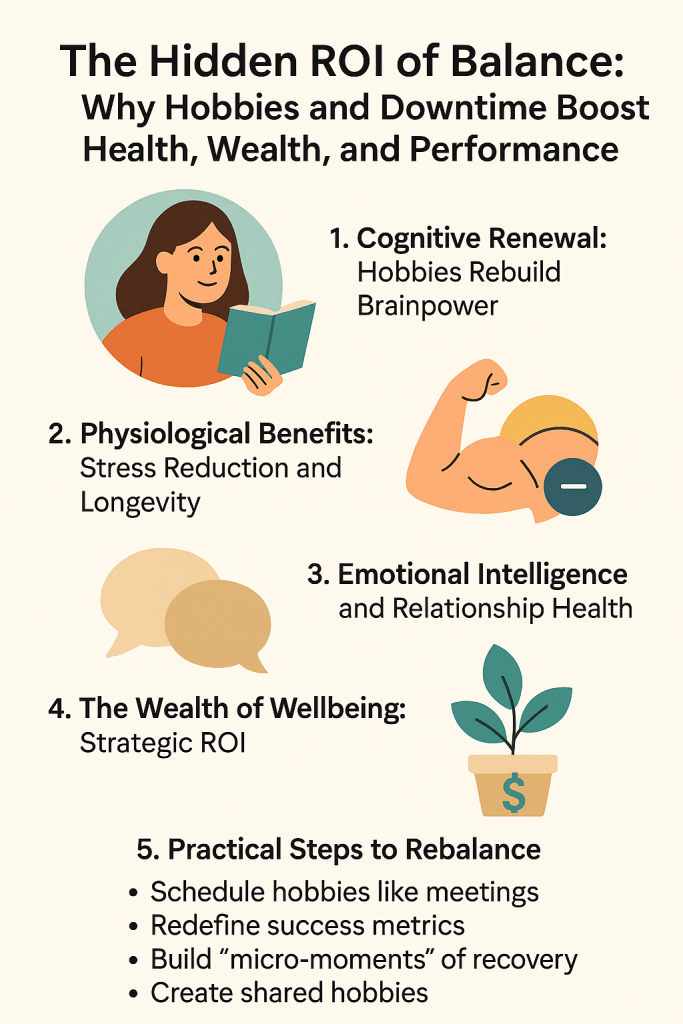
🌿 The Quiet Power of Balance
In private banking boardrooms and fintech startups alike, “balance” often sounds like a luxury. Yet data increasingly shows that maintaining a healthy work-life rhythm and pursuing hobbies outside of work directly improves not only personal health—but also long-term financial and professional outcomes.
High-performing professionals, entrepreneurs, and executives often trade rest for results. But the science of performance now tells a different story: strategic downtime and structured hobbies are productivity multipliers, not distractions.
🧠 1. Cognitive Renewal: Hobbies Rebuild Brainpower
A 2024 Harvard Business Review study found that professionals who regularly engage in creative hobbies—such as music, painting, or sports—report 31% higher problem-solving ability and up to 25% lower burnout risk.
When we immerse ourselves in activities that activate different parts of the brain, we enable neuroplastic recovery—the process through which the mind resets, forms new connections, and enhances creative thinking.
For financial decision-makers, this cognitive renewal translates into sharper analytical performance, more innovative deal structures, and better long-term investment judgment.
💪 2. Physiological Benefits: Stress Reduction and Longevity
Work-related stress remains one of the top health risks among executives. According to the World Health Organization (WHO, 2023), chronic stress contributes to over 70% of preventable workplace health issues, including cardiovascular disease and insomnia.
Balanced professionals—those who prioritize leisure time, hobbies, and physical exercise—show lower cortisol levels, improved heart rate variability, and longer lifespan markers, according to studies by Stanford Medicine (2022).
Simply put: your hobbies are a form of health insurance. Whether cycling, gardening, or playing piano, consistent engagement in non-work pursuits supports immune function, mood regulation, and sleep quality—all of which compound into better decision-making and resilience.
💬 3. Emotional Intelligence and Relationship Health
For leaders in finance and entrepreneurship, emotional intelligence (EQ) is as critical as IQ. Hobbies foster empathy, patience, and adaptability—traits essential for leadership and client trust.
A 2023 study by McKinsey Health Institute showed that leaders with balanced personal lives were 2.5x more likely to have engaged teams and 40% less likely to experience interpersonal conflicts at work.
Reconnecting with personal passions also strengthens social bonds, which directly correlate with higher happiness and reduced anxiety—both crucial for sustained performance under pressure.
🌱 4. The Wealth of Wellbeing: Strategic ROI
Investors and founders often ask, “What’s the ROI of rest?” The answer is quantifiable. Balanced executives experience:
+21% higher productivity (Gallup Workplace Study, 2024) +32% improvement in creativity metrics (MIT Sloan Review, 2023) Lower turnover and absenteeism costs in their teams
In wealth management, where trust and judgment underpin every transaction, clarity of thought is a currency. Work-life balance preserves this clarity—transforming personal wellbeing into professional leverage.
🪶 5. Practical Steps to Rebalance
1. Schedule hobbies like meetings. Treat your downtime as non-negotiable on your calendar.
2. Redefine success metrics. Include wellbeing KPIs alongside business goals.
3. Build “micro-moments” of recovery. Ten minutes of mindfulness or stretching between meetings compounds over time.
4. Create shared hobbies. Encourage your teams or clients to engage in community-based leisure—building both wellness and connection.

💫 Closing Insight
In the evolving economy of high performance, rest is strategy, and hobbies are assets. The wealthiest individuals—financially and emotionally—are those who design lives with balance built in.
Your health is your highest-yield investment. Protect it like your portfolio depends on it—because it does.
Sources
Harvard Business Review, Creativity and Burnout Prevention, 2024 McKinsey Health Institute, Leadership and Wellbeing Report, 2023 WHO, Workplace Health and Stress Findings, 2023 Stanford Medicine, Resilience and Recovery Study, 2022 Gallup, Workplace Engagement Survey, 2024 MIT Sloan Review, The Science of Rest and Performance, 2023
🔍 SEO Metadata
Meta title: Health Benefits of Work-Life Balance and Hobbies for High Performers
Meta description: Discover how maintaining work-life balance and pursuing hobbies can enhance mental health, reduce stress, and boost professional performance for leaders and wealth professionals.
Focus keywords: work-life balance, hobbies and mental health, executive wellbeing, performance and rest, professional burnout prevention.
 Fintech Cafe
Leave a comment