
By Fintech Cafe Editorial Team
Date: November 16, 2025
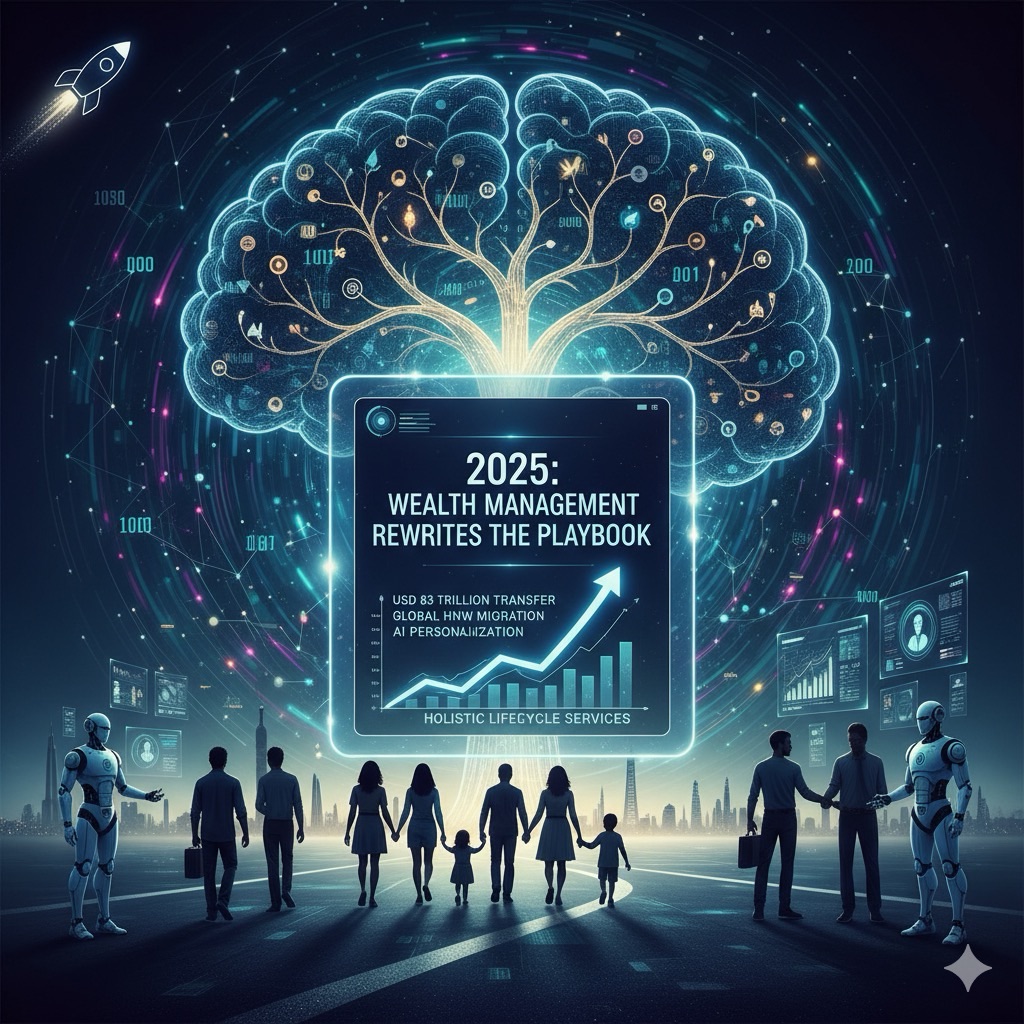
In 2025, wealth management is being rewritten by an USD 83.5 trillion generational wealth transfer, record HNWI migration, AI-driven personalization, and a shift to holistic, lifecycle-based advice. Here’s an executive roadmap for advisors, private banks, and family offices.
1. Why 2025 Is a Structural, Not Cyclical, Turning Point
2024 was a “good” year for wealth: global HNWI wealth grew 4.2% and the HNWI population 2.6%, according to Capgemini’s World Wealth Report 2025.
But underneath the aggregate growth, the operating rules for wealth managers are being rewritten:
A USD 83.5 trillion “Great Wealth Transfer” to Gen X, millennials and Gen Z is underway through 2048. Millionaire migration is hitting record levels with ~142,000 HNWIs projected to relocate globally in 2025, reshaping wealth hubs and tax bases. AI has moved from experimentation to scaled deployment: EY finds 95% of wealth and asset managers have already scaled GenAI to multiple use cases, with 78% exploring agentic AI. Clients are demanding holistic, lifecycle-based services, not just investment returns: 56% of HNWIs now explicitly want value-added services like tax, inheritance and estate planning.
For wealth advisors, private banks, and family offices, 2025–2027 will likely determine who stays relevant through the next two decades of capital reallocation—and who becomes a legacy brand remembered by the previous generation.
2. The USD 83.5 Trillion Wealth Transfer: From Event to Operating Environment
2.1 The scale and timing
Multiple large-scale studies now converge around the same magnitude:
UBS and Capgemini estimate roughly USD 83–83.5 trillion of wealth will be transferred globally over the next 20–25 years, largely to Gen X, millennials and Gen Z. UBS breaks this into USD 9 trillion in “horizontal” transfers between spouses and USD 74 trillion “vertical” transfers between generations, with the US alone accounting for more than USD 29 trillion.
In other words, the generational transfer is not a “future wave”—it is the macro backdrop for all wealth decisions between now and roughly 2048.
2.2 Who is inheriting—and what they expect
Next-gen HNWIs (Gen X, millennials, Gen Z) differ from their parents on three dimensions:
Digital and hybrid engagement expectations Capgemini finds that 55% of HNWIs value digital capabilities when choosing a firm, but 47% are dissatisfied with existing digital interfaces. Demand for holistic, non-investment services 56% of HNWIs want value-added services such as tax, inheritance, estate management and legal advice. Affluent clients (USD 250k–1m investable assets, often tomorrow’s HNWIs) hold nearly USD 27 trillion and similarly prioritize hyper-personalized, goal-aligned guidance. Low loyalty to their parents’ advisors Roughly 70% of heirs say they are inclined to change advisors after inheriting their parents’ wealth.
For wealth managers, the implication is stark: retention is not automatic. Relationships that are still structured around a single patriarch or matriarch risk being structurally misaligned with how wealth will be controlled in the next 20 years.
3. The Geography of Capital: Record HNWI Migration and New Wealth Hubs
3.1 Millionaire migration at record levels
Henley & Partners’ Private Wealth Migration Report 2025 projects that:
142,000 HNWIs will relocate in 2025, a new record and up from ~134,000 in 2024. The UAE, United States and Italy are top net gainers of millionaires, while the UK and China are among the largest net losers.
Drivers include tax regimes, political and regulatory stability, lifestyle quality, and investor residency programs such as the UAE’s Golden Visa.
3.2 What this means for wealth managers and family offices
For private banks, multi-family offices and trustees, record migration translates into:
Rising cross-border complexity: more clients with multi-jurisdictional tax residency, corporate structures and family members spread across countries. Jurisdictional diversification of family offices: growing use of second hubs (e.g., Dubai, Singapore, US, Southern Europe) for asset-holding structures, education, and succession planning. Silent churn risk: if your firm isn’t present or partnered in the destination markets (e.g., UAE, US, Italy, Portugal, Greece), client relationships can erode as local advisors capture wallet share.
Wealth managers who treat migration as a compliance issue only—rather than a strategic client-acquisition and retention lever—will miss one of the biggest flows of portable capital this decade.
4. AI-Driven Personalization Moves from Buzzword to Baseline
4.1 The adoption curve: from pilots to scaled use cases
EY’s 2025 GenAI in Wealth and Asset Management survey provides one of the clearest pictures of where the industry stands:
95% of firms have scaled GenAI to multiple use cases. 78% are already exploring agentic AI—AI systems that act more autonomously to monitor portfolios, detect life events and generate recommendations. Only ~27–29% report a substantial business impact so far, indicating that the next phase is about deep integration into the advisor workflow, not experimentation.
Capgemini’s work suggests that AI-driven personalization and automation can reduce routine advisor tasks by at least 25%, freeing capacity for higher-value client engagement.
KPMG highlights concrete use cases already in production: GenAI drafting financial plans for advisors to review, generating performance commentary, preparing advisors for meetings and summarizing complex content.
A Microsoft executive recently argued that AI will reshape wealth management much as earlier digitalization waves did—dramatically lowering barriers to entry and enabling smaller players and family offices to compete with large banks.
4.2 Where value is emerging first
Across EY, Capgemini and KPMG analyses, early GenAI value is concentrated in four buckets:
Compliance and risk Screening, monitoring, and documentation are being partially automated, generating measurable cost savings. Advisor productivity Drafting of proposals, plans, emails, and meeting preparation reduces non-client-facing work and shortens cycle times. Personalization at scale Firms report prioritizing personalized investment strategies and automated, personalized client outreach as top GenAI front-office investments over the next two years. Client engagement and education Natural-language interfaces and chat-based experiences allow clients to query portfolios, scenarios, risks and planning assumptions in ways that were previously advisor-only.
The competitive bar is therefore shifting from “we have digital” to “we have responsive, AI-enabled, human-curated guidance that feels bespoke.”
4.3 Fintech and ecosystem signals
Capital flows also indicate where incumbents see the future:
Goldman Sachs and Citigroup led an USD 80 million Series B into Conquest, an AI-driven financial planning platform used by around 60,000 advisors and 1,000 financial organizations, aiming to augment—not replace—human advice.
For traditional wealth firms, the message is clear: AI-native advice platforms are becoming foundational infrastructure, not experimental add-ons.
5. From Products to Life-Cycle Services: The Holistic Wealth Pivot
5.1 What “holistic” now means in practice
The term “holistic wealth management” has been used loosely for a decade, but in 2025 a more precise model is emerging:
Breadth of services: legal, tax, lending, insurance, business succession, philanthropy and family governance are increasingly bundled into core wealth offerings. Household and multigenerational orientation: firms are shifting from individual-centric to household-centric models, explicitly designing services for spouses, children and sometimes parents. Life-stage continuity: integrating accumulation, transition (liquidity/exit events), decumulation, caregiving, and legacy into a single planning architecture.
Capgemini emphasizes that 34% of global HNW wealth is already held by Ultra-HNWIs, a segment that demands 24/7 global access, tailored analytics, and multi-disciplinary teams to handle complexity and legacy.
5.2 Regulatory catalysts: SECURE 2.0 and US estate tax changes
In the US, regulatory timelines are pushing advisors toward more comprehensive planning:
The scheduled sunset of the expanded gift and estate tax exemption in late 2025 creates urgency around wealth-transfer strategies, as estates may face federal tax rates of 40% or more once exemptions revert. The continuing rollout of the SECURE 2.0 Act reshapes retirement saving and distribution for multiple generations, creating planning opportunities across age bands—especially for beneficiaries of the Great Wealth Transfer.
Advisors who stay narrowly focused on portfolios risk being disintermediated by estate attorneys, tax advisers or specialized planning platforms that speak more directly to these pain points.
6. The New Rules of Client Engagement (2025–2030)
Drawing on the data above, five “new rules” are emerging for how leading wealth managers and family offices will engage clients.
Rule 1: Design for households, not individuals
With 70% of heirs inclined to switch advisors, firms must institutionalize relationships with spouses and next-gen family members early, not as an afterthought during estate administration.
Rule 2: Make AI invisible but indispensable
The winning model is not “AI instead of the advisor,” but AI under the advisor’s hood—drafting, monitoring, segmenting and suggesting, while the human owns judgment, empathy and complex trade-offs.
Rule 3: Treat jurisdiction as a core design parameter
With millionaire migration at record highs, every strategic plan should be explicitly jurisdiction-aware, incorporating tax residency, asset location, second citizenships, and the regulatory profile of new hubs (e.g., UAE, US, Italy, Portugal, Saudi Arabia).
Rule 4: Expand the definition of “service quality”
HNWIs now evaluate firms on responsiveness, digital experience, depth of holistic services and proactivity, not just performance versus benchmark. Capgemini reports that advisors still spend only about a third of their time on pre-sales and client interaction, despite clear demand for richer engagement.
Rule 5: Embed succession into the operating model
The Great Wealth Transfer is no longer a special project; it must be encoded into onboarding, review cycles, reporting, and fee structures, ensuring continuity as control moves from founders to spouses to children and beyond.
7. Executive Roadmap: 12 Priorities for 2025–2027
Below is an action-oriented roadmap for wealth advisors, private banks and family offices. It is intentionally practical and aligned with the verified trends above.
7.1 Strategy & client segmentation
Re-segment your book around life-stage + complexity, not just AUM Explicitly tag clients as founders, spouses, inheritors, next-gen entrepreneurs, and cross-border families. Use this to drive differentiated service levels, communication styles, and advisory content. Define your stance on migration and second-citizenship flows Decide whether you will lead, partner or follow on issues like relocation, residency-by-investment, and new onshore/offshore hubs. Codify a “next-gen strategy” backed by real engagement Launch programs (education, co-investment deals, digital communities) that are explicitly aimed at Gen X, millennial and Gen Z inheritors.
7.2 Operating model & technology
Integrate GenAI into the advisor desktop, not just as a pilot tool Prioritize use cases with proven ROI: meeting prep, plan drafting, portfolio commentary, call notes, and personalized follow-ups. Invest in data foundations for personalization at scale EY finds 62% of wealth managers and 72% of asset managers plan to prioritize personalized investment strategies in the next two years, with strong focus on automated personalized outreach. To compete, firms need unified client data, clean household hierarchies, and clear governance around privacy and model usage. Adopt a “human-in-the-loop” AI governance model Define where AI can act autonomously (e.g., alerts, draft communications) versus where human sign-off is mandatory (e.g., suitability, cross-border structuring). Address regulatory and privacy concerns up-front; 84–88% of early adopters cite these as the largest hurdles. Leverage third-party AI platforms selectively Evaluate ecosystem partners (e.g., planning engines, behavioral analytics, advisor-support tools) rather than rebuilding everything in-house—mirroring moves by large players backing fintechs like Conquest.
7.3 Proposition & service design
Build a formal “holistic wealth services” menu Document and price services spanning: tax and estate planning, lending/credit solutions, philanthropy, insurance, business succession, and family governance. Where you lack internal capability, structure repeatable partnerships with specialists. Institutionalize household-level engagement Require that annual reviews include spouses and (where appropriate) adult children. Use separate “rooms” (physical or virtual) and tailored communications for different generations, particularly for sensitive topics like control and legacy. Embed regulatory inflection points into client journeys Build campaigns around US estate and gift tax changes, SECURE 2.0 features, and local regime shifts that materially affect wealth transfer and retirement.
7.4 Talent & culture
Upskill advisors on AI, cross-border issues and family dynamics EY notes that 68% of firms expect substantial workforce transformation over five years, particularly in middle- and back-office roles. Front-office talent must evolve from stock-picker to strategic guide, comfortable orchestrating experts and AI tools. Align incentives with long-term, multigenerational relationships Adjust KPIs and compensation to reward multi-household retention, cross-jurisdiction collaboration and next-gen engagement—not just near-term product flows.
8. Are You Ready for the New Playbook?
If you are a wealth advisor, private banker or family office executive, 2025 is less about predicting markets and more about re-architecting how you create value:
The wealth you manage will increasingly be controlled by digitally fluent, globally mobile inheritors. They will judge you on holistic problem-solving, life-cycle relevance and seamless experiences, not just performance charts. AI will quietly redraw the productivity frontier and lower entry barriers—faster than most governance and talent models are evolving.
The central question is the one you posed at the outset:
Are we ready for the new rules of client engagement and service delivery?
If the honest answer is “not yet,” 2025–2027 is your window to fix it—before the Great Wealth Transfer and global migration flows permanently reset the leaderboard.
Sources:
Capgemini, World Wealth Report 2025 and Wealth Advising 2024: Key Trends for Success, 2025 UBS, Global Wealth Report and commentary on the Great Wealth Transfer, 2024–2025 Henley & Partners, Private Wealth Migration Report 2025; Business Insider, millionaire migration coverage, 2025 EY, GenAI in Wealth and Asset Management Survey, 2025 KPMG, How AI Can Be Good News for Wealth Managers, 2024 Reuters, AI to Transform Wealth Management, Microsoft Executive Says, 2025 WealthManagement.com and other industry analyses on AI, holistic advice and planning trends, 2024–2025
 Fintech Cafe
Leave a comment