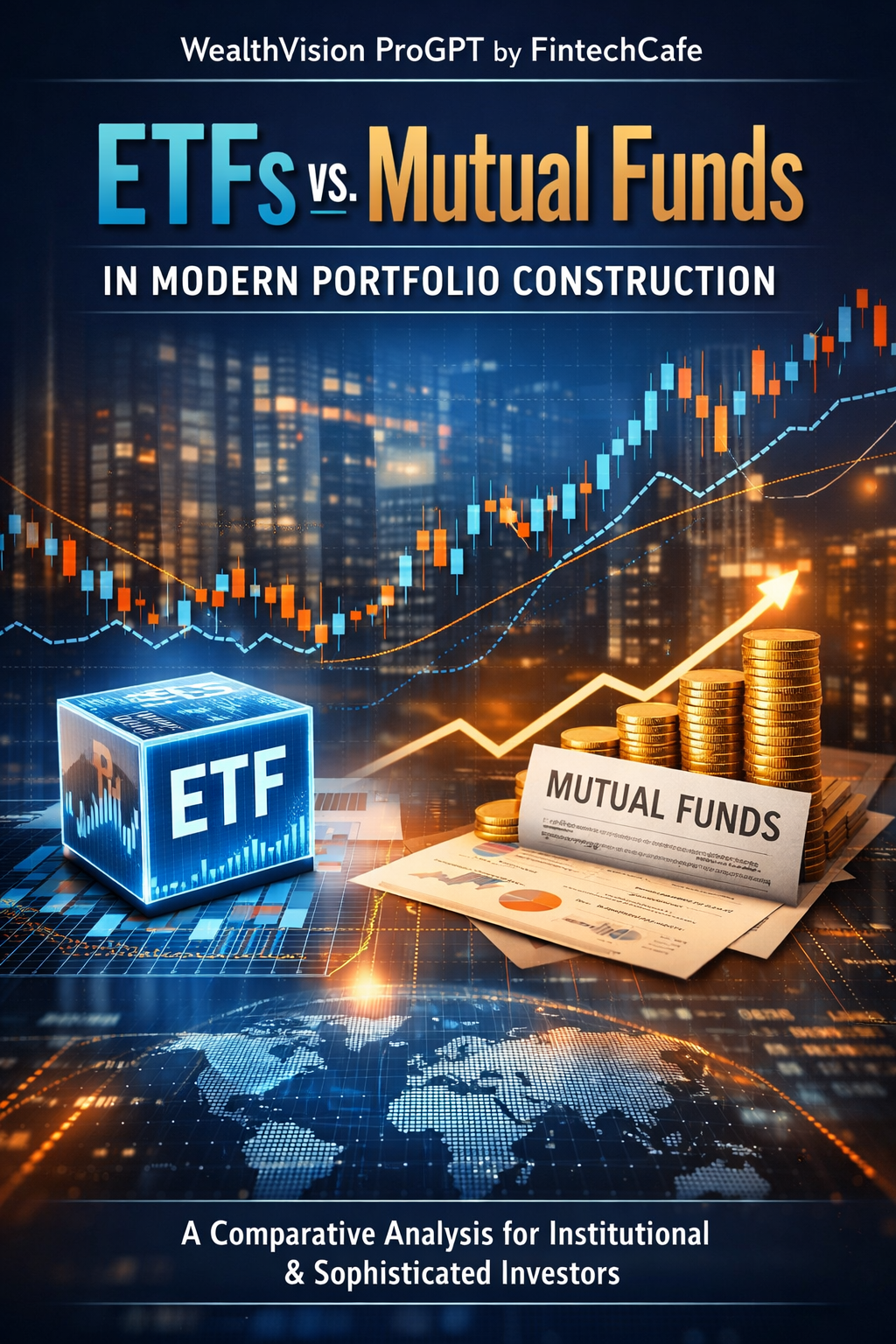

A Practitioner’s White Paper for Institutional and Sophisticated Investors
Author: WealthVision ProGPT by FintechCafe / Patricio Arrangoiz
Date: January 2026
Executive Summary
For more than three decades, mutual funds dominated professionally managed investment portfolios. Yet over the last 20 years—and especially since the Global Financial Crisis—Exchange-Traded Funds (ETFs) have transformed how portfolios are constructed, implemented, and managed. What began as a low-cost indexing tool has evolved into a sophisticated ecosystem supporting tactical asset allocation, liquidity management, risk hedging, and institutional-scale portfolio engineering.
This paper examines why ETFs are increasingly considered superior to mutual funds in modern portfolio construction. Drawing on research from Morningstar, BlackRock, Vanguard, the CFA Institute, and the Bank for International Settlements, the analysis evaluates ETFs and mutual funds across liquidity, taxation, transparency, cost efficiency, trading flexibility, and performance outcomes.
The conclusion is not that mutual funds are obsolete—but that ETFs are structurally better aligned with today’s market realities: higher volatility, tighter capital constraints, regulatory scrutiny, and greater demand for transparency and precision. ETFs are not a universal solution, but for most asset allocation and implementation needs, they represent a more efficient and adaptable vehicle.
1. The Structural Foundations: ETFs vs. Mutual Funds
At their core, ETFs and mutual funds often hold similar underlying securities. The difference lies not in what they own, but in how they are structured and traded.
Mutual funds are priced once per day at net asset value (NAV). Investors transact directly with the fund company, subscribing or redeeming shares at the closing NAV. Liquidity is provided by the fund itself, which must buy or sell underlying securities to meet flows.
ETFs, by contrast, trade intraday on exchanges like equities. Liquidity is provided through a dual-layer structure: secondary market trading between investors and a primary market mechanism involving authorized participants (APs), who create or redeem ETF shares in exchange for baskets of securities.
This distinction underpins nearly every advantage ETFs enjoy in modern portfolios.
2. Liquidity and Market Efficiency
2.1 Intraday Liquidity
ETFs offer continuous intraday liquidity, enabling investors to enter or exit positions in real time. This is not a cosmetic feature—it fundamentally alters portfolio management.
Institutional investors use ETFs to:
Adjust asset allocation during volatile markets Overlay tactical tilts without disturbing core holdings Manage cash equitization efficiently
Mutual funds, constrained by end-of-day pricing, cannot respond to intraday market dislocations. During periods of stress, this limitation becomes material.
2.2 The Myth of “ETF Liquidity Risk”
Critics often argue that ETF liquidity is illusory, especially in less liquid asset classes. However, ETF liquidity is best understood as derivative liquidity: it reflects the liquidity of the underlying securities, not just ETF trading volume.
BIS research has shown that in many bond markets, ETFs actually improve price discovery by concentrating trading activity and revealing real-time market clearing prices—something opaque over-the-counter bond markets historically lacked.
3. Cost Efficiency: The Compounding Advantage
3.1 Expense Ratios
Cost is one of the most empirically validated drivers of long-term investment outcomes. Across virtually every asset class, ETFs have structurally lower expense ratios than comparable mutual funds.
As of 2024:
Median passive equity ETF expense ratio: ~0.10% Median active equity mutual fund expense ratio: ~0.70%
Over a 25-year horizon, a 60 basis-point cost differential can reduce terminal wealth by 10–15%, assuming modest real returns.
3.2 Hidden Costs: Turnover and Cash Drag
Mutual funds often maintain cash buffers to manage redemptions, creating cash drag in rising markets. ETFs, through in-kind creation and redemption, remain fully invested.
Additionally, mutual fund turnover generates trading costs and taxable events borne by remaining shareholders—an inefficiency largely absent in ETF structures.
4. Tax Efficiency: A Structural Edge
Perhaps the most decisive advantage of ETFs—particularly for taxable investors—is tax efficiency.
4.1 In-Kind Redemptions
ETFs use in-kind redemptions to remove low-cost-basis securities from portfolios without triggering capital gains. This mechanism allows ETFs to “purge” embedded gains over time.
Morningstar data shows that:
Over 70% of equity ETFs distributed zero capital gains in recent years The majority of active equity mutual funds distributed taxable gains, even in down markets
4.2 Investor-Level Fairness
In mutual funds, one investor’s redemption can create a taxable event for all remaining investors. ETFs isolate tax consequences to the transacting party, aligning outcomes more equitably.
5. Transparency and Risk Management
5.1 Daily Holdings Disclosure
Most ETFs publish full portfolio holdings daily. Mutual funds typically disclose quarterly with a lag.
For institutional risk managers, daily transparency enables:
Accurate factor exposure analysis Real-time stress testing Regulatory and compliance monitoring
5.2 Factor and ESG Precision
The rise of factor-based and ESG investing has favored ETFs. Their rules-based methodologies and transparent indices allow investors to understand exactly what risks they are owning—value, momentum, low volatility, carbon intensity, or governance metrics.
Mutual funds, by contrast, often embed unintended factor bets that only become visible after performance diverges.
6. Trading Flexibility and Portfolio Engineering
6.1 Tactical Allocation and Hedging
ETFs can be:
Bought on margin Sold short Used with options Traded intraday with limit orders
This flexibility allows ETFs to function as portfolio building blocks rather than static investments.
Institutions increasingly use ETFs as:
Transition management tools Interim exposures during manager changes Overlay instruments for duration or equity beta control
6.2 Precision vs. Manager Discretion
Mutual funds rely on manager discretion, which can be valuable—but also introduces style drift and key-person risk. ETFs provide precision exposure, enabling investors to separate asset allocation from manager alpha.
7. Performance Outcomes: Evidence Over Ideology
7.1 Active Management Reality
SPIVA scorecards consistently show that over 10- and 15-year horizons, a majority of active mutual funds underperform their benchmarks net of fees.
ETFs, particularly passive ETFs, do not promise outperformance—but they reliably deliver benchmark returns with minimal slippage.
7.2 Tracking Error and Implementation
High-quality ETFs exhibit minimal tracking error, often less than 10 basis points annually for large-cap equity indices. For asset allocators, this predictability is a feature, not a bug.
8. Fund Flows and Institutional Adoption
8.1 The Data
By 2024:
Global ETF assets exceeded USD 11 trillion ETFs accounted for the majority of net inflows into long-term investment vehicles Mutual funds experienced persistent net outflows in developed markets
BlackRock and Vanguard research shows that pension funds, sovereign wealth funds, and insurance companies increasingly use ETFs not as substitutes for active management, but as complements.
8.2 ETFs as Infrastructure
ETFs are becoming financial infrastructure—tools embedded in:
Model portfolios Outsourced CIO platforms Robo-advisory frameworks Risk parity and liability-driven strategies
9. Counterarguments: Where Mutual Funds Still Matter
A balanced analysis must acknowledge where mutual funds retain advantages.
9.1 Capacity-Constrained Active Strategies
Certain strategies—small-cap, micro-cap, private credit, niche emerging markets—may be better executed in mutual fund or closed-end formats due to liquidity constraints.
9.2 Behavioral Guardrails
For some retail investors, mutual funds’ lack of intraday trading can reduce behavioral mistakes such as panic selling or excessive trading.
9.3 Systematic Withdrawal and Retirement Plans
Mutual funds remain operationally convenient in retirement plans where fractional trading, automatic investments, and NAV-based pricing are preferred.
10. Forward-Looking Perspective: The Future of ETFs
Looking ahead, ETFs are poised to expand further into:
Active transparent and semi-transparent strategies Fixed income and private asset proxies Tokenized and blockchain-settled structures Customized and direct indexing hybrids
Regulators and central banks increasingly view ETFs as stabilizing forces—provided market structure continues to evolve responsibly.
From a portfolio construction standpoint, ETFs align with the dominant trends shaping global finance:
Lower costs Higher transparency Modular, outcome-oriented investing Data-driven risk management
Conclusion
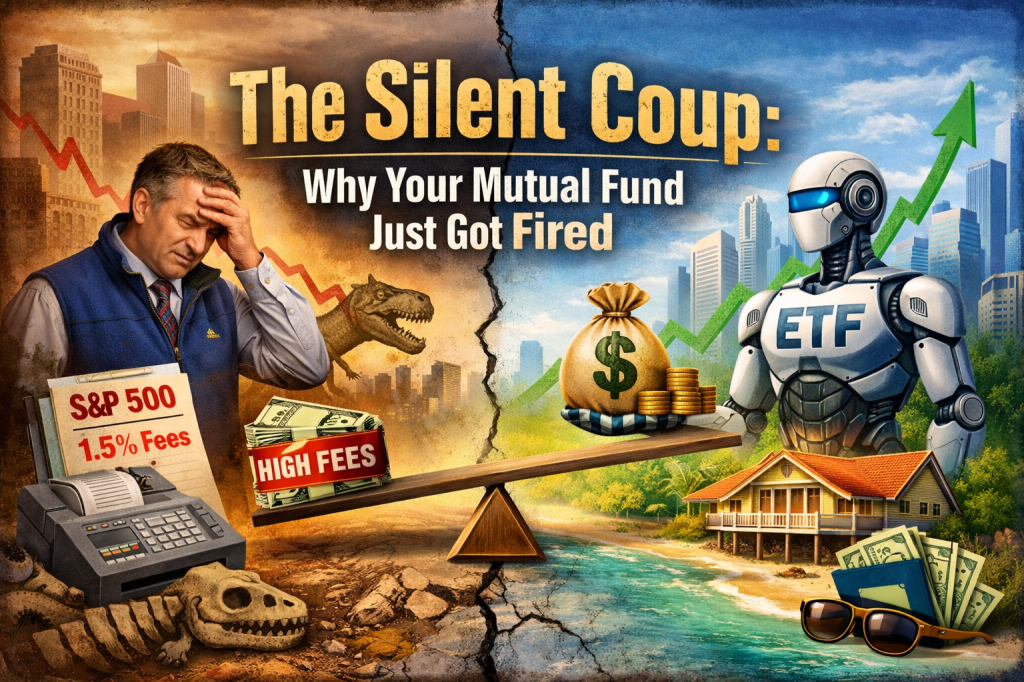
ETFs are not superior because they are fashionable—they are superior because their structure is better suited to modern portfolio demands. Liquidity, tax efficiency, transparency, cost control, and trading flexibility combine to create a vehicle that empowers both institutional and sophisticated retail investors.
Mutual funds still have a role, particularly in specialized active strategies and behavioral contexts. But for core allocations, tactical implementation, and scalable portfolio construction, ETFs represent the most efficient financial innovation of the past half-century.
In an era defined by uncertainty and complexity, the ETF is not merely a product—it is a portfolio architecture.
Sources 🌐
Morningstar Research, Global Fund Flows and Investor Outcomes (2023–2025) BlackRock Investment Institute, ETF Landscape and Market Structure (2024) Vanguard, The Case for Low-Cost Indexing (2023) CFA Institute, Investment Foundations & Portfolio Management Research Bank for International Settlements, Market Liquidity and ETF Resilience
For institutional insights on ETFs, asset allocation, and wealth strategy, visit FintechCafe.blog.
 Fintech Cafe
Leave a comment